Visalys® Restorative Primer
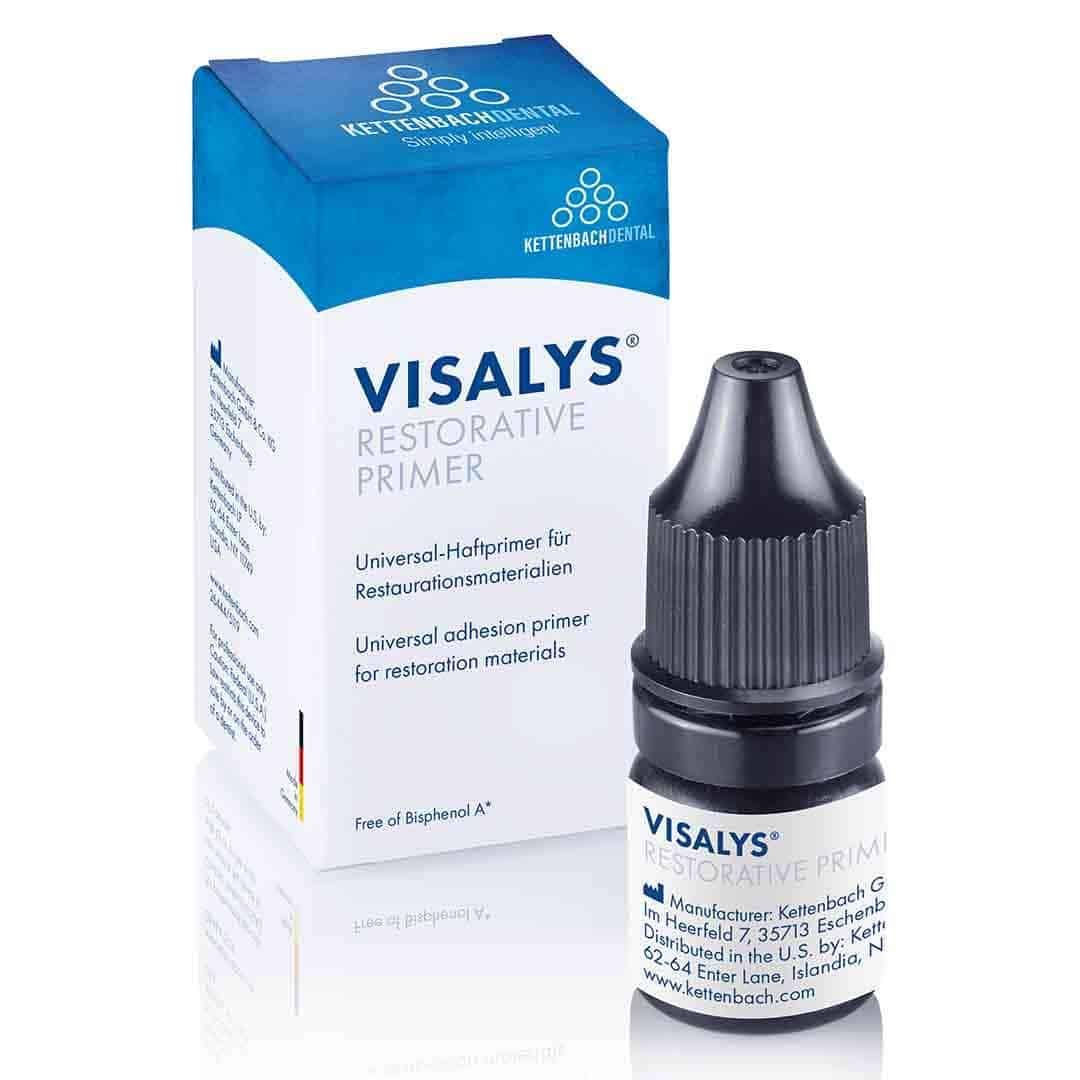
Visalys® Restorative Primer is a primer with adhesive monomers (10-MDP, silane methacrylate) for building bonding surfaces on restorative materials (metals, composites, silicate and oxide ceramics). The Visalys® Restorative Primer is a one-component primer. Do not light cure. Visalys® Restorative Primer is free from bisphenol A and its derivatives.
Product description
Visalys® Restorative Primer is a primer with adhesive monomers (10-MDP, silane methacrylate) for building bonding surfaces on restorative materials (metals, composites, silicate and oxide ceramics). The Visalys® Restorative Primer is a one-component primer. Visalys® Restorative Primer is free from bisphenol A and its derivatives.
Restoration Primer for the pretreatment of metal, silicate ceramic, oxide ceramic and composite surfaces
- for fixing prosthetic restorations
- for repairing fractured restorations with composite materials
Visalys® Restorative Primer is free from bisphenol A and its derivatives.
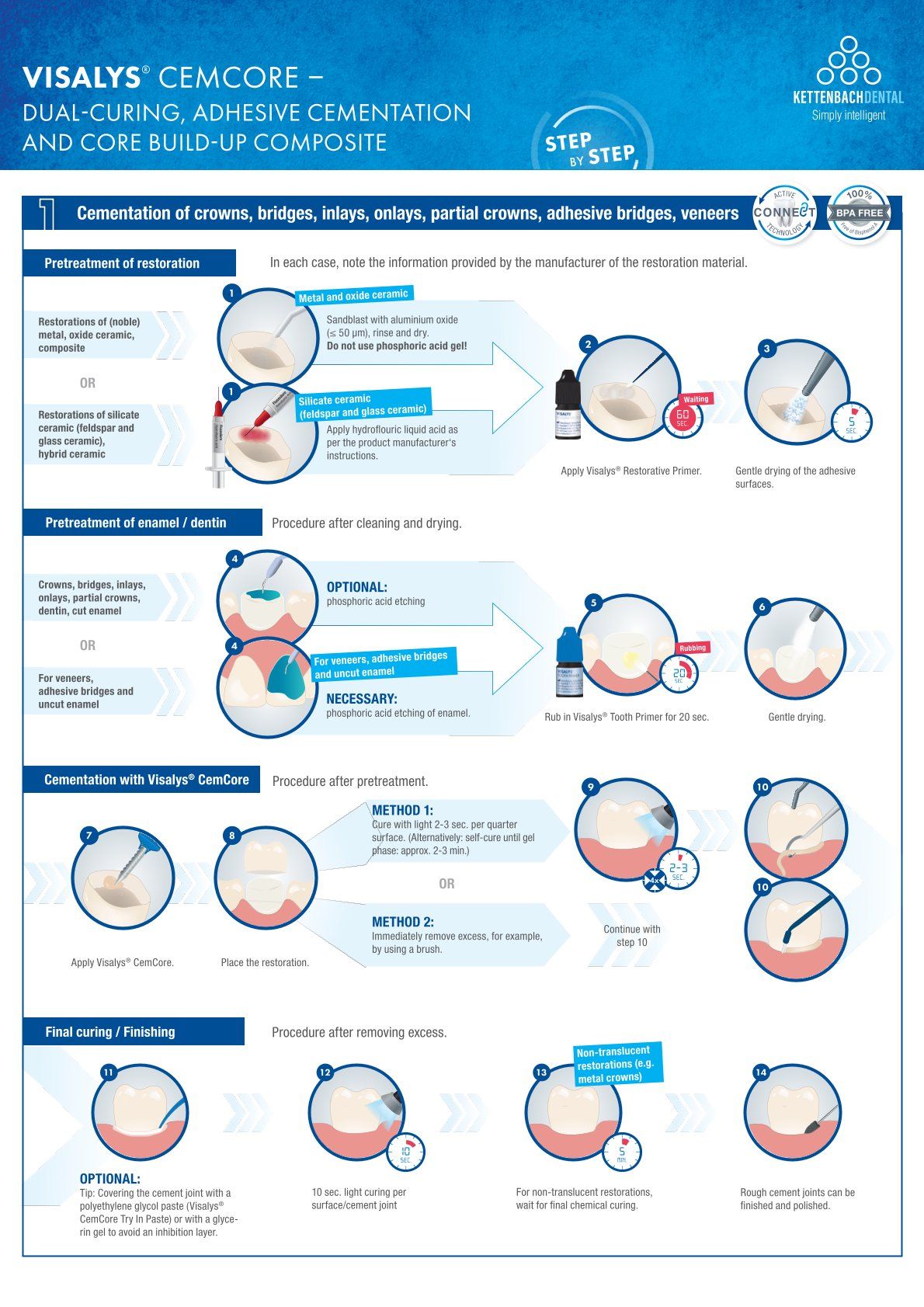
Please see our step-by-step guide. Always follow the instructions for use and the manufacturer’s instructions. Do not light-cure Visalys® Restorative Primer.
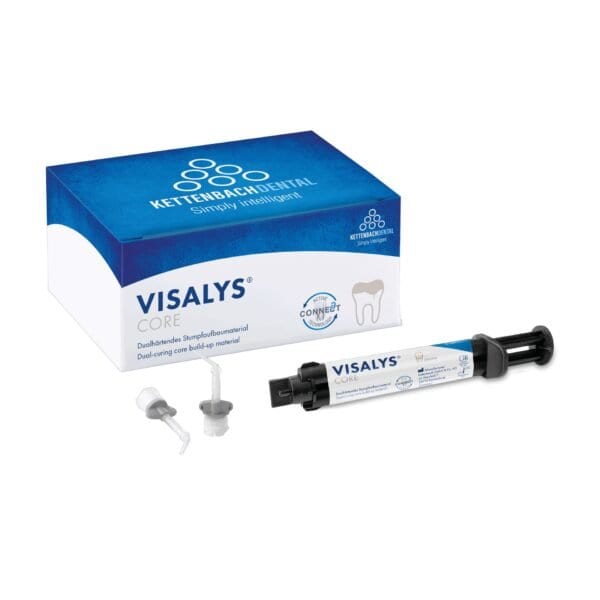
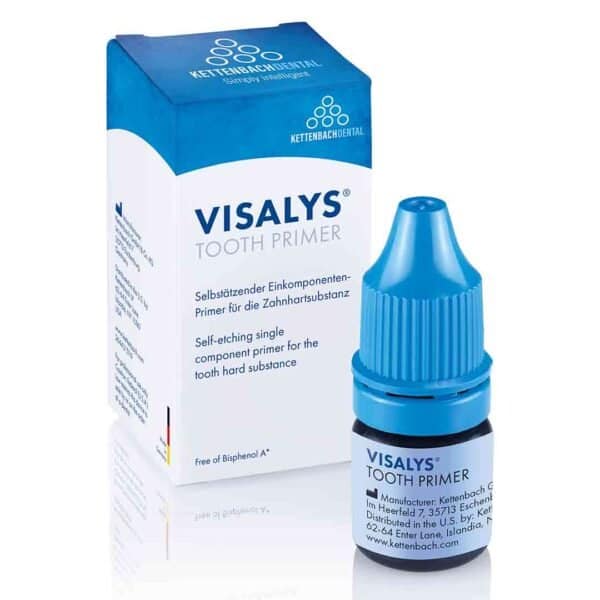
Additional information
| Indication / Technique | Cementation of all indirect restorations, Core build-up / root post cementation |
|---|---|
| Type of packaging | Bottle (4 ml) |
| Application method | Brush |
| Colour | Transparent/blue |
No, light curing is not required. This means that the primers are also effective in areas that are difficult for light to access (e.g. root canal) and premature curing by ambient light is impossible. Blockage and fitting problems caused by too thick primer layers are avoided. In addition, one work step is omitted.
Accidental light curing of the primers is not harmful.
No. Although the use of a restoration primer is mandatory, other restoration primers suitable for the respective surface can also be used.
This combination is contraindicated and not according to the instructions for use. Adhesion may be compromised.
In a bonding test (ISO 29022), the combination of Visalys® Tooth Primer and Visalys® CemCore achieves sufficient bonding strength on all surfaces (≥ 5 MPa). On glass ceramics, adhesion is only minimally above the threshold value of 5 MPa, as without the silane contained in Visalys® Restorative Primer, proper bonding is not possible.
The values, however, are significantly poorer than the intended combination of Visalys® Restorative Primer and Visalys® CemCore.
Always choose the correct material combination (Visalys® Tooth Primer for tooth substrate only, Visalys® Restorative Primer for restorative materials). The IFU and step-by-step instructions are helpful tools to guide you through the process.
It is important to determine whether the bonding failed on the tooth side (with residual composite cement on the resin-bonded bridge) or on the restoration side (with residual composite cement on the tooth surface).
Resin-bonded bridges can be somewhat challenging, as they require high bond strength while offering only a limited surface for adhesion. In this case, we recommend selectively etching the enamel surface (see the information in the instructions for use).
For the resin-bonded bridge itself, we recommend following the established procedures, depending on the material of the bridge:
- In the case of zirconium dioxide: sandblasting.
- In the case of silicate ceramic: etching with hydrofluoric acid.
In both cases, Visalys® Restorative Primer is applied as usual.
The pretreatment of the restoration surface / resin-bonded bridge is very important, as increasing the surface area (through sandblasting or hydrofluoric acid etching) is the key factor for successful bonding.
Before cementation with Visalys® CemCore, Visalys® Tooth Primer is first applied to the tooth surface.
Resin-bonded bridges can be somewhat challenging, as they require high bond strength while offering only a limited surface for adhesion. In this case, we recommend selectively etching the enamel surface (see the information in the instructions for use).
For the resin-bonded bridge itself, we recommend following the established procedures, depending on the material of the bridge:
- In the case of zirconium dioxide: sandblasting.
- In the case of silicate ceramic: etching with hydrofluoric acid.
In both cases, Visalys® Restorative Primer is applied as usual.
The pretreatment of the restoration surface / resin-bonded bridge is very important, as increasing the surface area (through sandblasting or hydrofluoric acid etching) is the key factor for successful bonding.
Before cementation with Visalys® CemCore, Visalys® Tooth Primer is first applied to the tooth surface.
Visalys® CemCore is the best choice for preventing tooth fractures for several reasons: Thanks to its extremely low water absorption properties, the risk of tooth fracture is reduced. Visalys® CemCore is a 2-in-1 dual-curing luting composite and core build-up material. It offers excellent dimensional stability and, with its unique Active-Connect Technology, guarantees optimal adhesive bond for all indirect restorations. With Visalys® CemCore, you really are on the safe side: The material is also 100% free from bisphenol A.
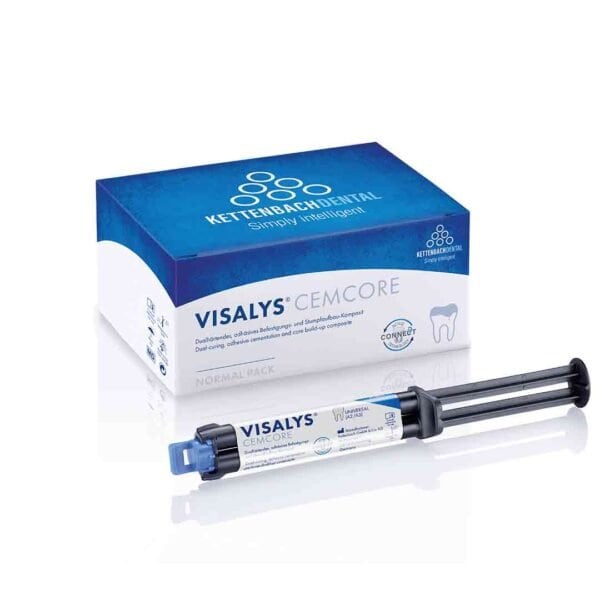
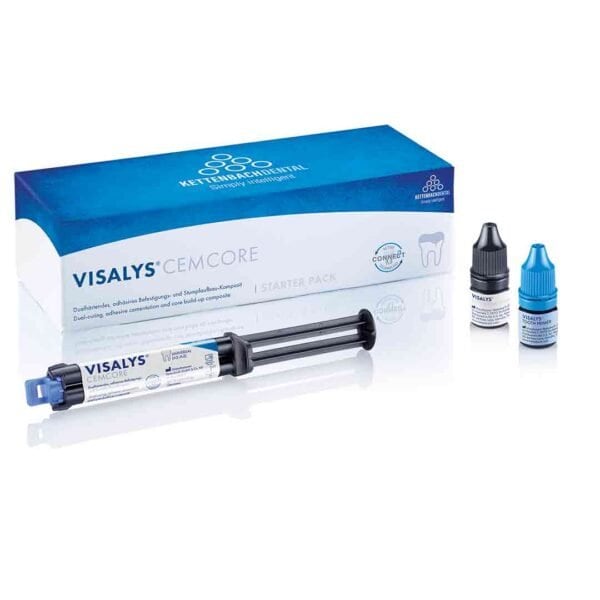
Visalys® CemCore from Kettenbach Dental is a dual-curing luting composite designed for safe and predictable cementation of all indirect restorations. This 2-in-1 product can also be used for fabricating core build-ups and build-up fillings. The unique, patented Active-Connect Technology eliminates typical conflicts and enables optimal mixing of the somewhat hydrophobic composite Visalys® CemCore with the hydrophilic Visalys® Tooth Primer on the damp tooth surface, resulting in a permanently high adhesive bond. Visalys® CemCore features excellent flow properties, is radiopaque, bisphenol-A-free, and ready to use.