Restoration
From TEMPORARY to PERMANENT – uncompromising strength.
Versatile, aesthetic and durable – discover our strong VISALYS® product family for professional restoration.
Whether light-curing or dual-curing, for temporary or permanent restorations, whether for core build-up, cementation or bulk fillings – with VISALYS® you can’t go wrong.
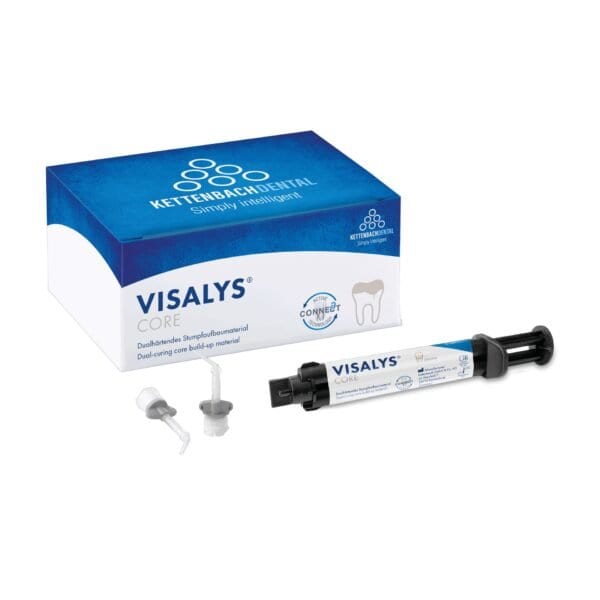
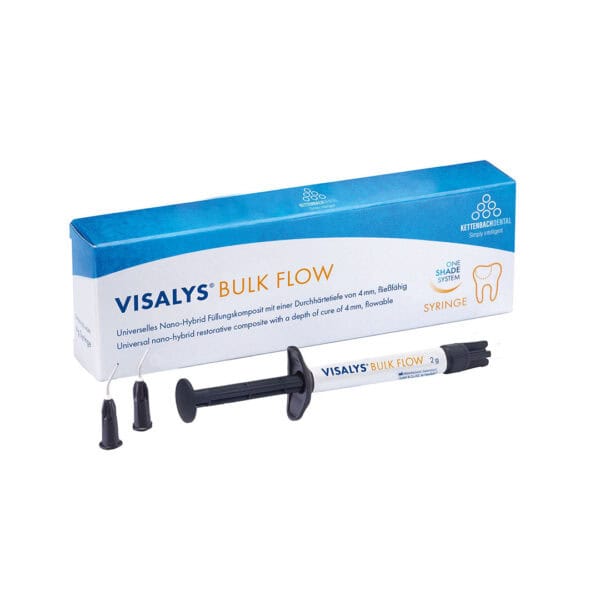
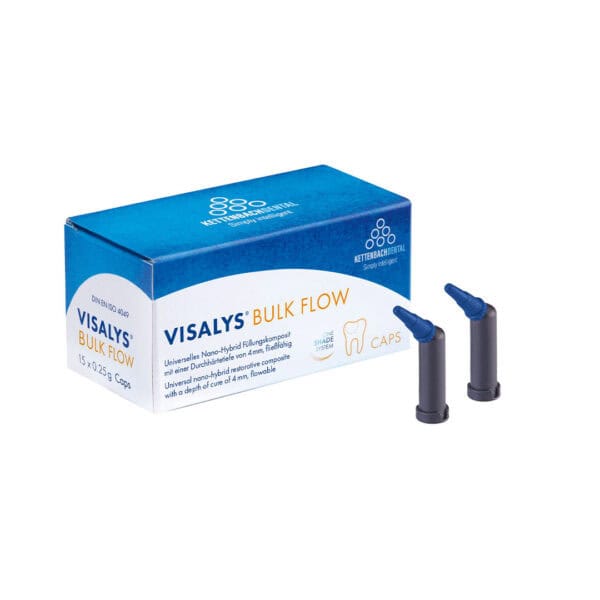
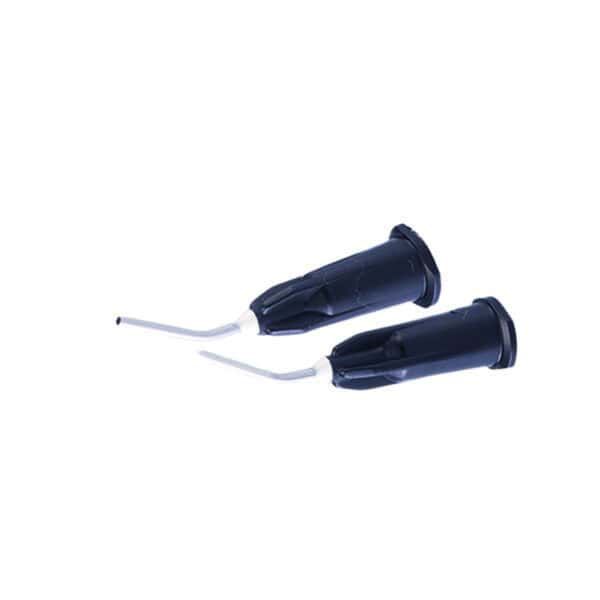
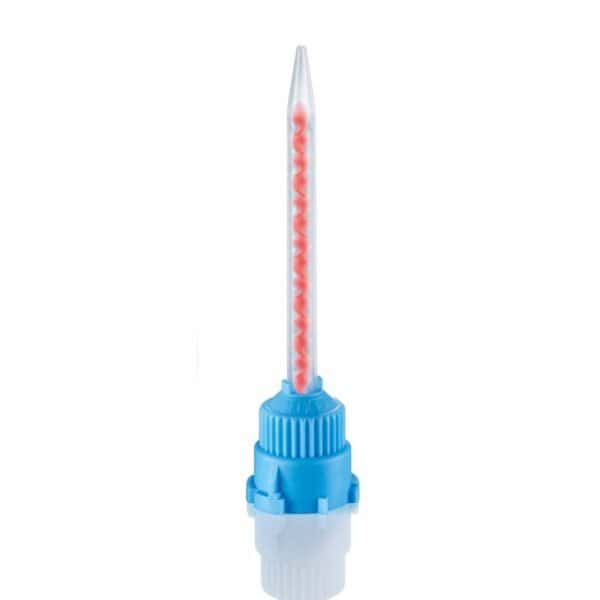
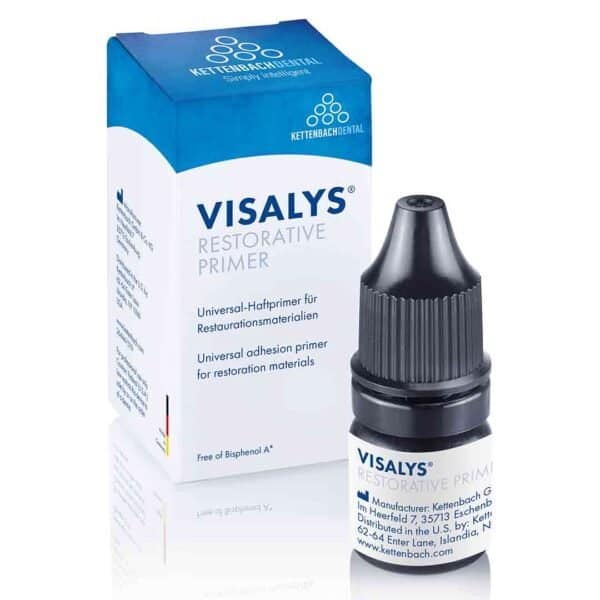
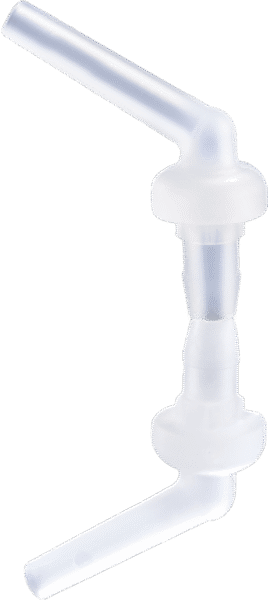
Intraoral tips, transparent, ø 1.2 mm (for Visalys® Core / CemCore)
WELCOME20
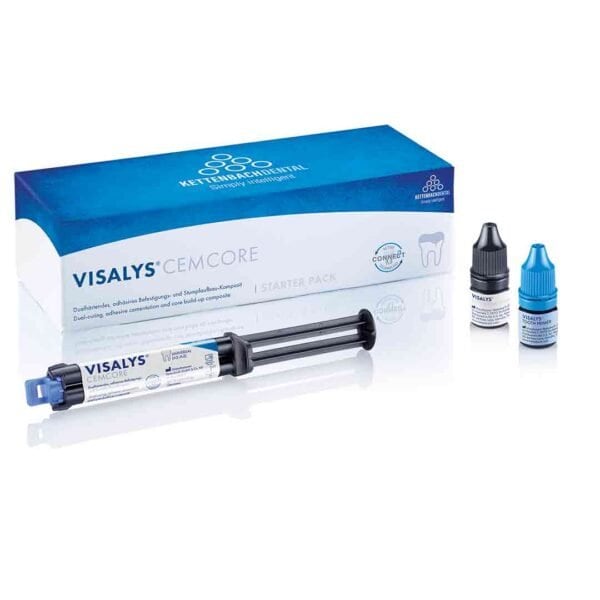
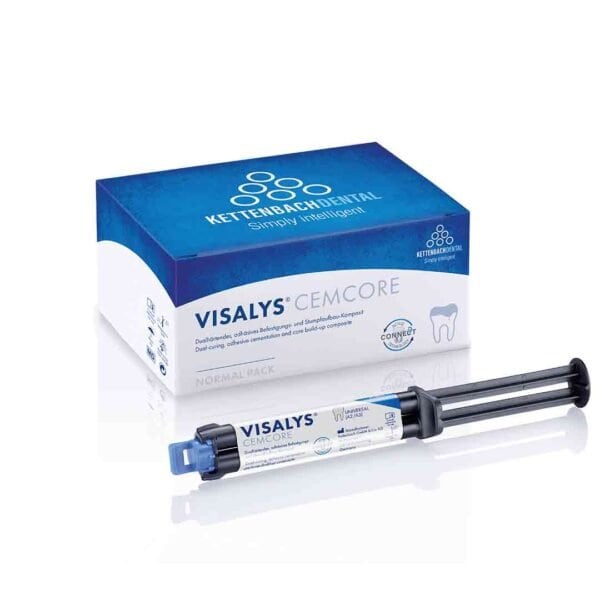
Visalys® CemCore is the best choice for preventing tooth fractures for several reasons: Thanks to its extremely low water absorption properties, the risk of tooth fracture is reduced. Visalys® CemCore is a 2-in-1 dual-curing luting composite and core build-up material. It offers excellent dimensional stability and, with its unique Active-Connect Technology, guarantees optimal adhesive bond for all indirect restorations. With Visalys® CemCore, you really are on the safe side: The material is also 100% free from bisphenol A.
Visalys® CemCore from Kettenbach Dental is a dual-curing luting composite designed for safe and predictable cementation of all indirect restorations. This 2-in-1 product can also be used for fabricating core build-ups and build-up fillings. The unique, patented Active-Connect Technology eliminates typical conflicts and enables optimal mixing of the somewhat hydrophobic composite Visalys® CemCore with the hydrophilic Visalys® Tooth Primer on the damp tooth surface, resulting in a permanently high adhesive bond. Visalys® CemCore features excellent flow properties, is radiopaque, bisphenol-A-free, and ready to use.
It is important to determine whether the bonding failed on the tooth side (with residual composite cement on the resin-bonded bridge) or on the restoration side (with residual composite cement on the tooth surface).
Adhesive bridges can be somewhat challenging, as they require high bond strength while offering only a limited surface for adhesion. In this case, we recommend selectively etching the enamel surface (see the information in the instructions for use).
For the Maryland bridge itself, we recommend following the established procedures, depending on the material of the bridge:
- In the case of zirconium dioxide: sandblasting.
- In the case of silicate ceramic: etching with hydrofluoric acid.
In both cases, Visalys® Restorative Primer is applied as usual.
The pretreatment of the restoration surface / resin-bonded bridge is very important, as increasing the surface area (through sandblasting or hydrofluoric acid etching) is the key factor for successful bonding.
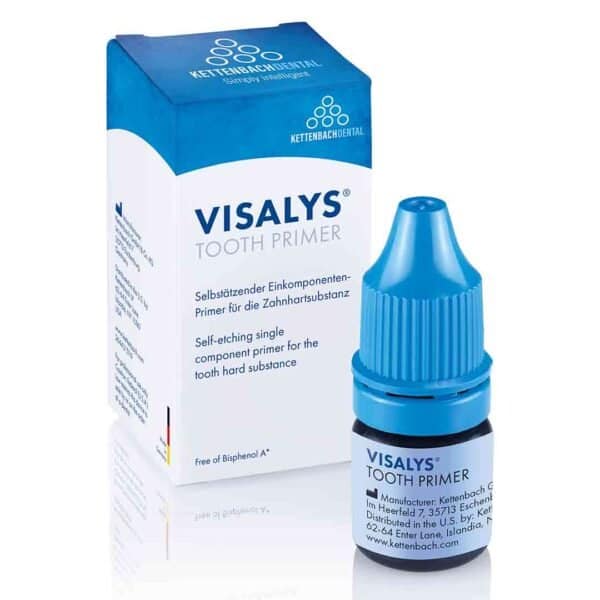
Before cementation with Visalys® CemCore, Visalys® Tooth Primer is first applied to the tooth surface.
This combination is contraindicated and not according to the instructions for use. Adhesion may be compromised.
In a bonding test (ISO 29022), the combination of Visalys® Tooth Primer and Visalys® CemCore achieves sufficient bonding strength on all surfaces (≥ 5 MPa). On glass ceramics, adhesion is only minimally above the threshold value of 5 MPa, as without the silane contained in Visalys® Restorative Primer, proper bonding is not possible.
The values, however, are significantly poorer than the intended combination of Visalys® Restorative Primer and Visalys® CemCore.
Always choose the correct material combination (Visalys® Tooth Primer for tooth substrate only, Visalys® Restorative Primer for restorative materials). The IFU and step-by-step instructions are helpful tools to guide you through the process.
Adhesive bridges can be somewhat challenging, as they require high bond strength while offering only a limited surface for adhesion. In this case, we recommend selectively etching the enamel surface (see the information in the instructions for use).
For the Maryland bridge itself, we recommend following the established procedures, depending on the material of the bridge:
- In the case of zirconium dioxide: sandblasting.
- In the case of silicate ceramic: etching with hydrofluoric acid.
In both cases, Visalys® Restorative Primer is applied as usual.
The pretreatment of the restoration surface / adhesive bridge is very important, as increasing the surface area (through sandblasting or hydrofluoric acid etching) is the key factor for successful bonding.
Before cementation with Visalys® CemCore, Visalys® Tooth Primer is first applied to the tooth surface.
The Visalys® Tooth Primer can also be used as an adhesive/primer with Visalys® Core. Use with other composites is not indicated.
Yes. Visalys® CemCore is also suitable for attachment to common implant abutments. The abutment must be pre-treated according to the specifications of the respective manufacturer.
No. Although the use of a restoration primer is mandatory, other restoration primers suitable for the respective surface can also be used.
Yes. The excellent adhesion values to the tooth substance can only be achieved by combining Visalys® CemCore and Visalys® Tooth Primer.
No, light curing is not required. This means that the primers are also effective in areas that are difficult for light to access (e.g. root canal) and premature curing by ambient light is impossible. Blockage and fitting problems caused by too thick primer layers are avoided. In addition, one work step is omitted.
Accidental light curing of the primers is not harmful.
For pre-treatment, the instructions of the post manufacturer must be observed. If an adhesive/primer is required, the Visalys® Restorative Primer is suitable.
Yes. The root canal must be cleaned and dried. The surfaces in the root canal are then wetted with the Visalys® Tooth Primer.
Glycerine can be used to cover the cement joint excellently.
All remnants of the temporary cement must be removed. The stump surface is cleaned with water spray and then dried. Any remaining tooth structure must be pre-treated with the Visalys® Tooth Primer according to the instructions. Subsequently, the restoration can be directly attached with Visalys® CemCore without further pre-treatment of the composite surfaces.
Dual-curing composites without Active Connect Technology often do not cure completely on acid-etched tooth surfaces and/or those pretreated with adhesive or primer and require an additional activator (referred to as self-cure activators (SCA)).
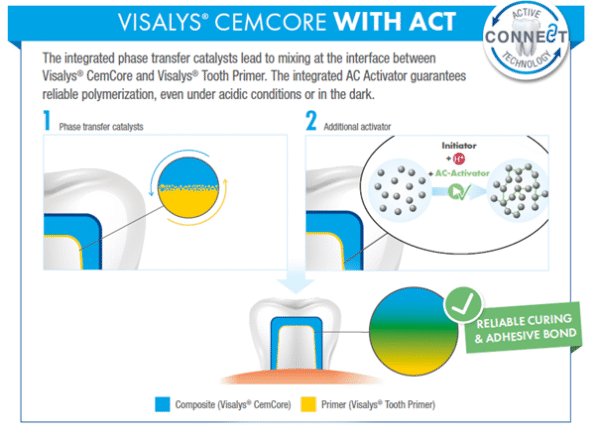
Cementation composites must be as hydrophilic as possible while also having very good flowability. Core build-ups require a high degree of stability and a material that swells as little as possible. Kettenbach Dental has developed a groundbreaking technology that simply eliminates the conflicts: Active-Connect-Technology (ACT) allows optimal mixing of the somewhat hydrophobic cementation composite Visalys® CemCore with the hydrophilic Visalys® Tooth Primer on the damp surface of the tooth. The innovative composite achieves a high adhesive strength despite its hydrophobic properties while also avoiding swelling.
After the contact of Visalys® CemCore (hydrophobic) with the water-based VISALYS® Tooth Primer (hydrophilic), which penetrates deep into the tooth surface, the phase transfer catalyst is activated:
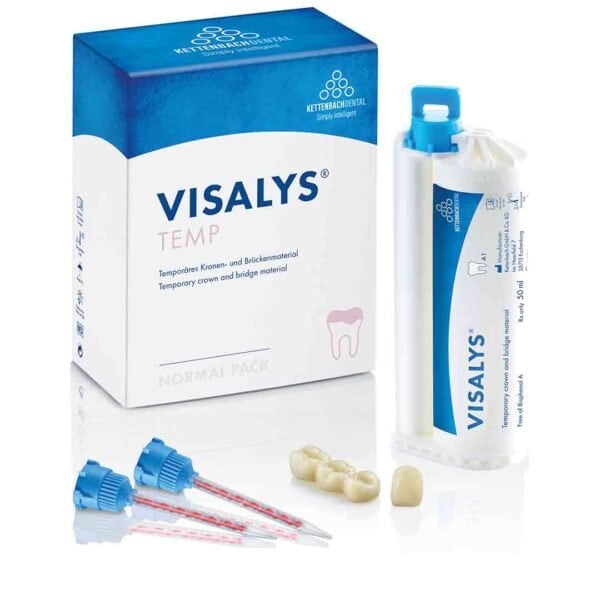
Visalys® Temp from Kettenbach Dental is ideal for the fabrication of temporary crowns, bridges, inlays, onlays, and veneers. It is perfectly suitable for long-term temporaries and has exceptional fracture resistance and very good marginal stability. It offers excellent flow, thixotropy, stability, and user-friendliness. It has a low smear layer and finishes quickly and beautifully to a high gloss. Its natural translucency and opalescence provide for seamless integration in the oral situation, and it is a safe choice as it does not contain bisphenol A.
Visalys® Temp from Kettenbach Dental is a reliable and aesthetic restorative material. It is exceptionally stable and user-friendly, making it ideal for the fabrication of temporary crowns and bridges (as well as provisional inlays, onlays, and veneers). Offering exceptional fracture resistance and stability, it carries a low risk of fracture and is also suitable for long-term temporary restorations.
The ideal time for removal depends on the personal preference of the user: Some users prefer it when the temporary is still relatively elastic – others want the temporary restoration to be very hard when it is removed from the mouth. On the other hand, the individual oral situation must also be taken into account: If, for example, there are large undercuts, it is better to remove the temporary restoration at an early stage.
Yes.
Yes. Any composite can be used for repairs, e.g. Visalys® Bulk Flow.
Yes. Visalys® Temp is compatible with any impression material. However, an A-silicone impression is recommended (e.g. Silginat® or Panasil® Putty), as it can be stored and reused for possible repairs or for remaking the provisional.
In principle, yes. Cross-toothed burs made of stainless steel have proven particularly effective.
Yes. However, ensure that eugenol-free temporary cements are used if it is planned to incorporate the subsequent permanent restoration of a composite cement. Eugenol (clove oil) can impair the chemical curing of the composite cement.
In principle, yes. Cotton buffs have proven particularly effective.
Burs can quickly become dull if the smear layer has not been removed beforehand. Therefore, removing the smear layer before milling is definitely recommended. With Visalys® Temp, it can be done very quickly with a disinfectant wipe, for example.
Nitrile can interfere with the bonding of Visalys® Temp (and other temporary crown and bridge materials). Although direct contact with the glove before curing is very unlikely, vinyl or latex gloves are recommended.
CAVE: Considering your workflow, keep in mind that latex gloves can have a negative effect on the curing of A-silicones.
The curing of the temporary restoration should be checked extraorally, e.g. by means of a material sample on the glove, and intraorally. As soon as the material is so hard that it can be easily pressed in with a fingernail or a probe and an impression remains, the temporary restoration can be removed from the patient’s mouth at the earliest.
Visalys® Temp continues to harden afterwards. After approx. 4 minutes, the material is hard enough that it can be finished well and no longer deforms even under high pressure.
Yes. Visalys® Temp is a composite as well and could chemically interact with existing composite restorations. Therefore, all composite fillings and core build-ups should be insulated beforehand, for example with petroleum jelly (Vaseline).
Newly created temporary restorations still contain the lubricating layer, which reacts during a repair or addition, thus creating a chemical compound. This is not the case with older temporary restorations, so milling and bonding serve to create a better chemical bond.
No. Visalys® Temp is purely self-curing.