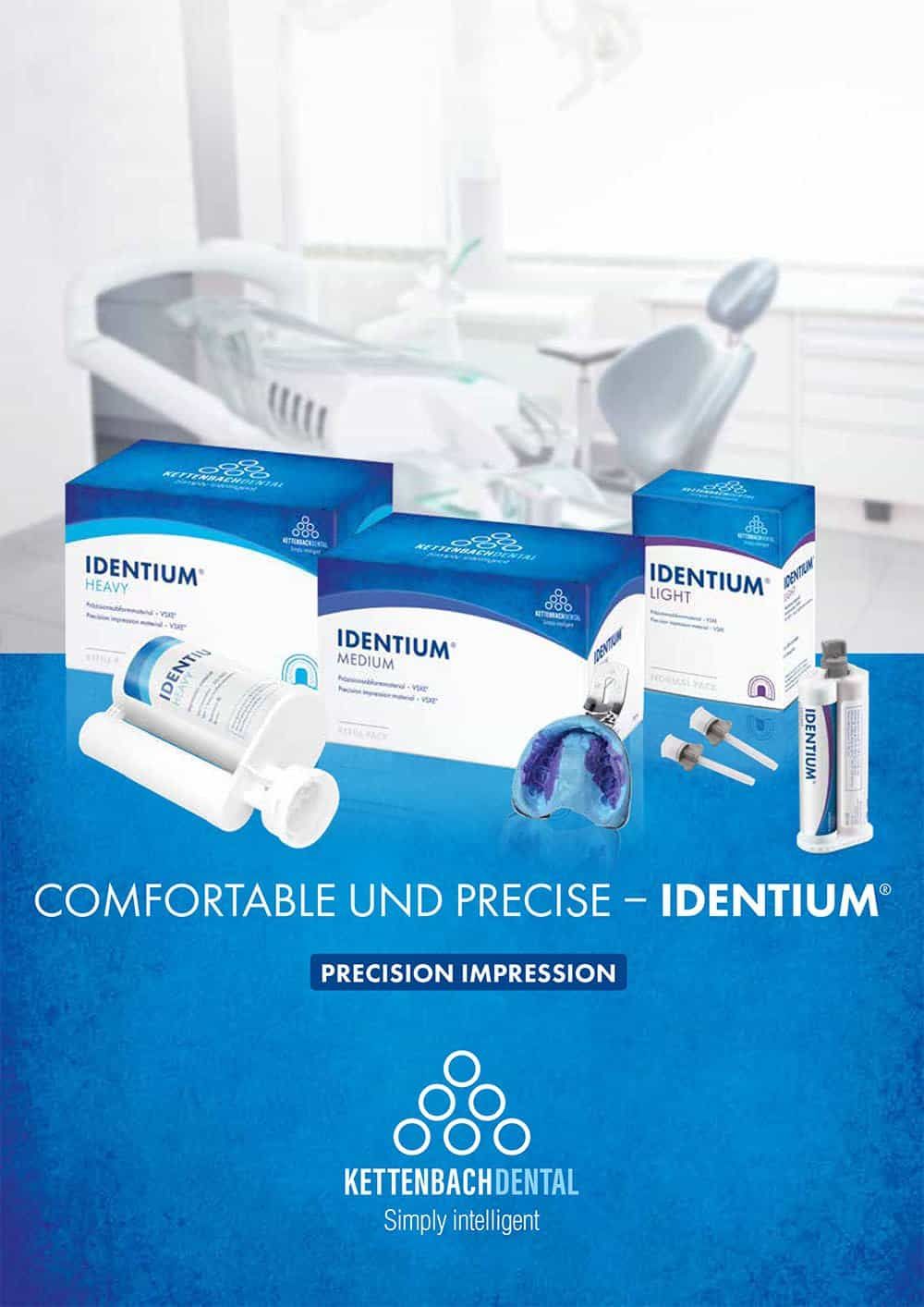
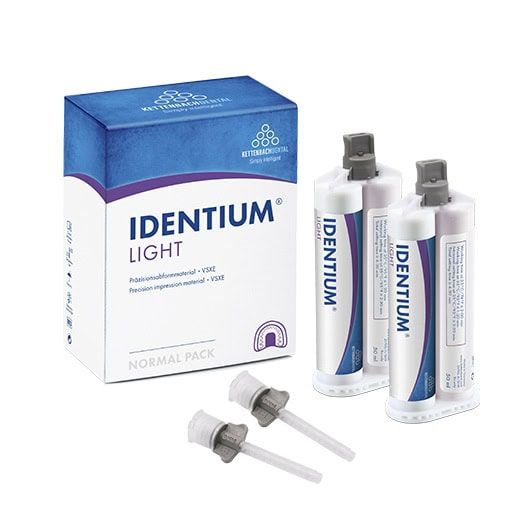
Identium® Light Normal pack
WELCOME20
2 x 50ml, 8 mixing tips
Why choose between accuracy and comfort? IDENTIUM® harmonizes the distinct advantages of polyether and A-silicones. Its standout feature? Comfort that doesn’t compromise on results. The material is incredibly easy to remove from the mouth and is truly neutral in both – odour and taste.
IDENTIUM® LIGHT is a low-viscosity wash material designed to capture the finest marginal details, best combined with IDENTIUM® HEAVY or IDENTIUM® MEDIUM for the one-step (double-mix) technique to achieve ultimate accuracy. Neither bleeding nor saliva will prevent your preparation margins from being captured in crisp, sharp detail.
Product description
IDENTIUM® LIGHT – The Detail Specialist: This low-viscosity wash material is designed to capture the finest marginal details. It flows effortlessly into the moistest areas of the sulcus, ensuring pin-sharp margins for crowns, bridges, and implant abutments. It maintains its stability without dripping, giving you the precision you need exactly where it matters.
Taking a precise impression shouldn’t be a struggle. IDENTIUM® is engineered to deliver a perfect “first-time” result, providing total confidence even in the most challenging situations:
- Extreme Precision in Any Environment: Accuracy is non-negotiable. IDENTIUM® delivers where others fail; its unique “water-loving” (hydrophilic) formula seeks out detail even in the moistest areas around the sulcus or implant abutments. This ensures pin-sharp margins, even when faced with residual moisture or saliva.
- Perfect synch with your lab: What you see in the chair is exactly what the lab receives: Once captured, the material’s excellent elastic recovery (memory) ensures the impression remains dimensionally stable over time.
- Easy Removal & Patient Comfort: Unlike traditional polyethers, IDENTIUM® is surprisingly easy to remove from the mouth, reducing the risk of tearing and protecting your patient’s existing restorations. Combined with a neutral taste and short intraoral setting time, it makes the procedure much more pleasant for your patient.
With IDENTIUM®, you get the unparalleled detail of a premium material combined with the smooth, easy handling your daily routine deserves.
- Best combined with: IDENTIUM® HEAVY or IDENTIUM® MEDIUM for the one-step (double-mix) technique to achieve ultimate accuracy.
Possibly also interesting…
Product specifications
Additional information
| Content | 2 x 50 ml, 8 mixing tips |
|---|---|
| Type of material | Polyether properties, Vinylsiloxanether |
| Indication / Technique | one-step impressions, pick-up impressions |
| Shore hardness (ca.) | A50 |
| Setting time | Regular |
| Working time (≤ 23 °C) | 2 minutes |
| Intraoral setting time (≥ 35 °C) | 2 minutes and 30 seconds |
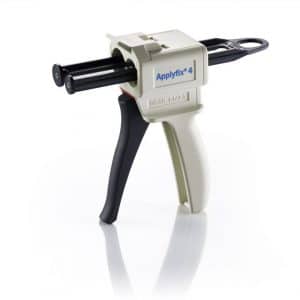
| Application method | Dispensing gun (50ml, 1:1/2:1) – Applyfix 4 |
| Consistency | Type 3: (X-)Light |
Frequently asked questions
Yes, absolutely. A mixing tips’s diameter and length must be matched to the material. Some mixers available on the market appear to be suitable, but do not mix homogeneously. To ensure best results, always use original Kettenbach Dental mixing tips. Compatible accessories are always displayed on the product sites.
Do not use latex gloves. Latex has a negative effect on the curing of A-silicones and Identium® and can cause poor-quality impressions.
We generally recommend the use of impression trays that allow sufficient pressure to build up, especially with medium (Type 2) and heavy body (Type 1) impression materials. Closed trays as well as custom trays are suitable; perforated trays are not recommended. When selecting a ready-made tray, it is important to choose a well-fitting, rigid tray. Stock trays can be customized for higher pressure build-up by blocking out the palatal area or the posterior end of the tray.
When selecting the tray size, always ensure that the distance from the tray wall to the tooth equator is at least three times the depth of the undercut. It is of course also important to use a tray that fits as well as possible, which provides adequate but not excessive space and thus permits optimal pressure build-up.
We recommend using a custom tray when taking impressions with impression posts and for fixation impressions. Prefabricated trays can also be customized by damming around the palate area or on the end of the tray for a greater build-up of pressure. The distance between tray wall and tooth equator should be at least 3 times greater than the depth of the undercut.
A good individual tray requires a preliminary impression. If trays are printed, it is preferable to make the preliminary impression with a scan-optimised impression material.
Any inhibition layer on the plastic individual tray can interfere with the setting of the impression material and must be thoroughly removed before use.
Every impression material shrinks (minimally) and in order to make this shrinkage predictable and controllable, it is important to be able to create an even impression material thickness between the elements and the inside of the impression tray. Because adhesion occurs between the tray and the impression material, this material shrinkage always occurs towards the tray wall. The more shrinkage the impression material has, the greater the cement thickness will be when placing the crown and bridge work. It is important that the tray is not too tight; in addition to blocking out undercuts, sufficient impression space (at least 4 to 5 mm) must also be left.
- Select appropriate impression tray, ensure proper size and fit.
- Apply Kettenbach Dental Universal Adhesive 5 min before taking the impression.
- Prepare the oral situation: Block out large undercut areas, expand the sulcus and control bleeding. For subgingival preparation margins, use retraction cords. If applicable, clean the prepared stumps.
- Prepare impression material and accessories: Bring material to room temperature. Depending on type of cartridge, discard some material. Mix the material homogeneously and fill the tray completely and continuously without interruption. Leave the mixing tip in the material when filling the tray to avoid bubbles. For hand-mixed putties, maintain a 1:1 ratio of catalyst to base material. Do not use latex gloves or polyether “contaminated” accessories. If applicable, thoroughly remove any inhibition layer on the surface of custom trays.
- Insert the filled impression tray into the patient’s mouth as vertically as possible to the occlusal plane. Set a timer according to the indicated setting time. Hold the tray in position, do not fully depress. Do not hand the impression tray over to others.
- After the material has completely set, remove the impression tray as vertically as possible to the occlusal plane with a slight rotational movement.
- Rinse, dry and disinfect the impression.
General guidance: Always follow manufacturer instructions and observe working and setting times. To ensure best results, use original mixing tips.
For more tips, consult our product-specific FAQs and troubleshooting guide.
Longer or shorter setting times (than indicated):
- The material could be too warm or too cold. Always bring the impression material to room temperature first: working and setting times are affected by higher or lower temperatures.
- With a hand-mixed A-silicone putty, it is important that the ratio of catalyst to base material is 50/50%; otherwise, setting times may be affected.
No / delayed setting:
- Do not use latex gloves.
- Discard a little material at first (jumbo cartridge) / before each (50 ml cartridge) use.
- Do not mix different types of material. Use dedicated accessories (e.g. application syringes) for each type of material (e.g. polyether vs. A-silicone), do not use accessories “contaminated” with other types of materials
- Retraction agents containing ferric sulfate, epinephrine or aluminium chloride may have a negative effect on the setting. When using such materials, rinse area thoroughly.
No adhesive bonding:
- The adhesive must be dry before the tray is filled with impression material.
- To allow the tray adhesive to work effectively, ensure that there is no inhibition layer on the surface of custom trays. If necessary, remove the smear layer with alcohol or mechanically.
General tips:
- Leave the mixer in the material when dispensing to avoid air bubbles.
- To ensure best results, always use original mixing tips.
- Always follow manufacturer guidances.
Impression material should be stored in a dry place at room temperature. Direct sunlight and extreme temperature changes must be avoided. If storage temperature is clearly below/above room temperature, bring the impression material to room temperature before use. If the impression material is too cold during impression taking, the setting times will be longer than stated, and if you are working in a (too) warm room, the processing and setting times will be much faster than normal.
Before taking an impression, any bleeding must be brought under control. Retraction cords and liquids containing ferric sulfate, epinephrine or aluminium chloride can lead to setting inhibition. Therefore, after using such materials, the contaminated areas must be thoroughly rinsed. Remove retraction cord or paste and any cotton rolls from the patient’s mouth just before inserting the tray into the patient’s mouth.
Before processing Identium® impression material, first bring the impression material to room temperature. Processing and curing times are affected by higher or lower temperatures. Do not use latex gloves or a polyether “contaminated” impression syringes. First remove the inhibition layer (lubricant layer) from an individual tray before taking an impression.
Temperature (warmer or colder than room temperature), latex and a polyether “contaminated” impression syringe, as well as the inhibition layer (lubricating layer) of a temporary restoration material left behind on the preparation, can adversely affect the curing of the Identium® impression material. Furthermore, some retraction agents may have a negative effect on curing; however, we have not received any complaints about this in relation to Kettenbach impression materials for decades.